10 min read
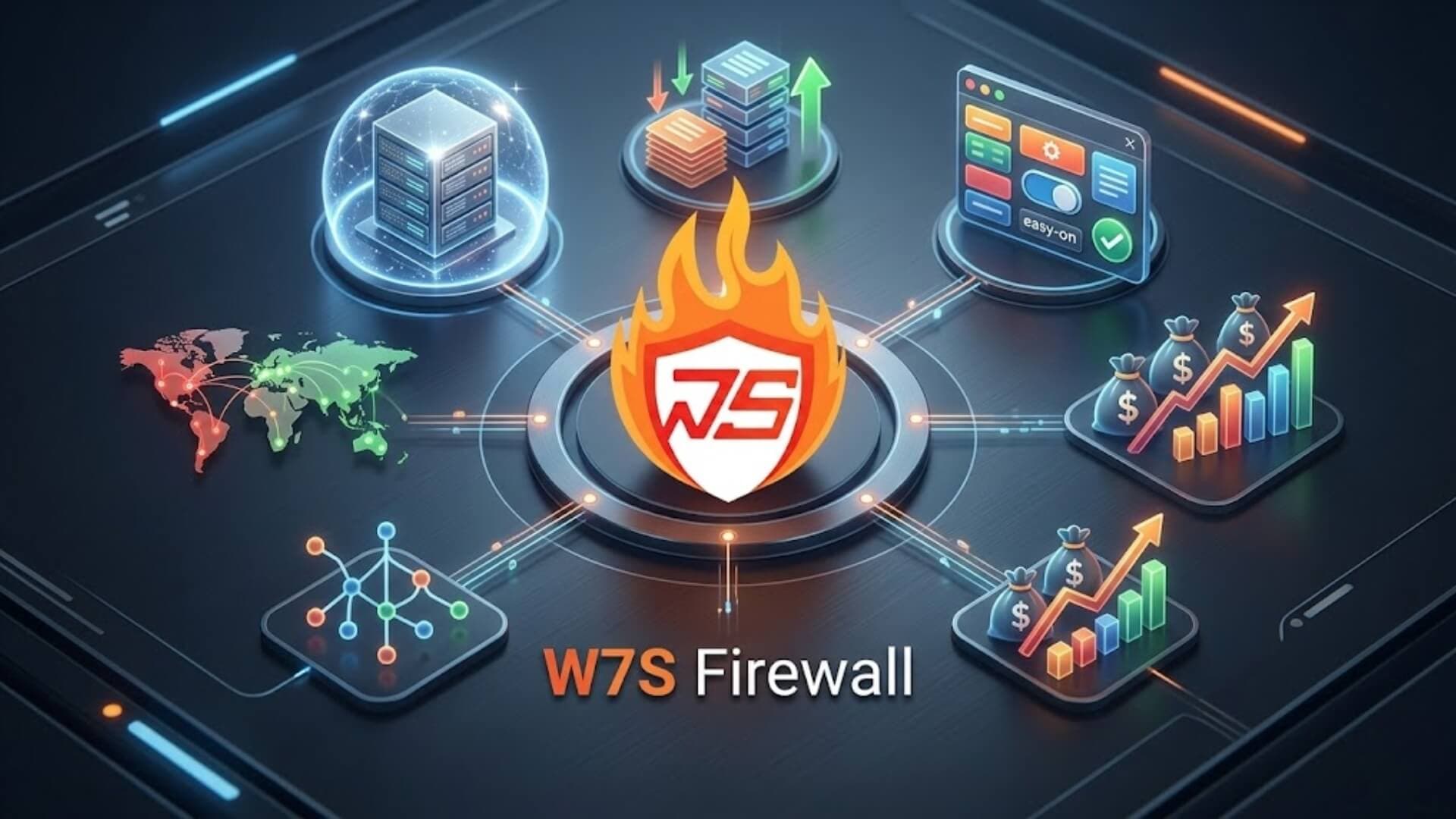
The rapid expansion of WordPress has transformed it into the backbone of the modern web, but this dominance comes with an unavoidable consequence: it has become a primary target for large-scale cyberattacks.
As vulnerabilities in plugins and themes continue to grow at an alarming rate, hosting providers are now facing a security burden that extends far beyond server uptime, requiring them to deal with increasingly frequent and sophisticated application-layer threats.
W7SFW is designed to intercept malicious traffic before it reaches WordPress, helping providers reduce support tickets, improve server stability, and offer stronger security as part of their hosting service. This article outlines 6 key reasons why hosting providers should activate W7SFW to strengthen WordPress security, reduce operational pressure, and build a more stable, scalable protection layer for their customers.
The growing security challenge for Hosting ProvidersLink to heading

WordPress currently powers 42.2% of all websites worldwide and accounts for 59.6% of the CMS market. Its massive ecosystem, with more than 62,000 plugins and 14,000 themes, has made WordPress the most dominant website platform today. However, this popularity also makes it one of the biggest targets for cyberattacks.
According to Patchstack’s State of WordPress Security in 2026 report, more than 11,332 WordPress vulnerabilities were disclosed in 2025 alone, a 42% increase compared to the previous year. Most importantly, 91% of these vulnerabilities originated from plugins, while nearly half remained unpatched at the time of disclosure. In many cases, attackers began exploiting vulnerabilities within just a few hours after publication.
For hosting providers, this creates a major operational challenge. Traditional security approaches, such as antivirus software or plugin-based firewalls, are no longer sufficient against modern WordPress attacks. Patchstack’s research shows that standard protection layers blocked only 12% to 26% of real-world attack attempts, meaning the majority of exploits can still bypass existing defenses.
As a result, hosting providers are often forced into a continuous support cycle: Attack → Server overload → Website failure → Support ticket → Temporary cleanup → Reinfection.
The problem becomes even more difficult because most WordPress users lack technical security knowledge. Unsafe plugin usage, outdated components, and weak configurations frequently lead to compromises, yet customers still expect hosting providers to handle the consequences regardless of the root cause.
In practice, hosting providers are no longer responsible only for infrastructure uptime. They are increasingly expected to protect customers from application-level WordPress threats as well.
Why traditional WordPress security solutions are no longer effectiveLink to heading
As WordPress attacks become more advanced and automated, many traditional security solutions are struggling to provide effective protection. Most websites today still rely on security plugins installed directly inside WordPress or antivirus systems running on hosting environments. While these approaches can block certain common threats, they also expose several major limitations in real-world environments.

Traditional firewalls react too lateLink to heading
One of the biggest weaknesses of traditional WordPress firewall plugins is that they only inspect traffic after the request has already reached the server and entered the WordPress environment.
In practice, this means malicious requests are still allowed to consume server resources before being analyzed or blocked. More importantly, certain attacks such as: Malware injection, web shell uploads, redirect injections, exploit execution attempts, may already begin affecting the system before the firewall reacts.
As a result, protection becomes reactive rather than preventive, significantly reducing the overall effectiveness of the security layer.
Increased server load and performance issuesLink to heading
Most security plugins add an additional processing layer inside WordPress. Every incoming request must pass through the plugin before a decision is made.
Under normal traffic conditions, this may already increase CPU and RAM usage. During bot attacks, brute-force attempts, or automated vulnerability scans, the impact becomes much more serious. Consequences often include:
- Higher server resource consumption
- Slower website performance
- Increased response time
- Hosting or VPS overload
- Reduced stability during traffic spikes
Instead of reducing infrastructure pressure, traditional firewall plugins can unintentionally become another source of system overhead.
Heavy dependence on signature-based detectionLink to heading
Most conventional security solutions rely heavily on signature matching or predefined attack patterns. In other words, the firewall can only block threats it already recognizes. This approach creates a serious limitation against:
- Zero-day vulnerabilities
- New exploit techniques
- Modified attack payloads
- Advanced bypass methods
Attackers today constantly change request structures and behaviors to avoid detection. If a threat does not match an existing signature, many traditional firewalls simply fail to recognize it in time.
This is one of the main reasons modern WordPress attacks can bypass standard protection layers so easily.
Complex configuration and high risk of misconfigurationLink to heading

Many firewall plugins require manual configuration to function properly. Website owners or hosting support teams often need to:
- Configure security rules
- Adjust whitelist and blacklist settings
- Fine-tune protection sensitivity
- Resolve false positives manually
Without sufficient technical knowledge, incorrect configurations can easily lead to:
- Legitimate users being blocked
- 403 access errors
- Broken website functionality
- Compatibility issues with plugins or themes
For hosting providers, this often translates into a growing number of technical support requests and operational overhead.
Instability inside the WordPress environmentLink to heading
Because traditional firewall plugins operate within the same environment as WordPress plugins, themes, caching systems, and server optimizations, conflicts are difficult to avoid. In many cases:
- Plugin updates break firewall behavior
- Cache systems interfere with protection rules
- WordPress core updates create compatibility problems
- Security plugins conflict with other extensions
This creates long-term operational instability and increases the risk of unexpected website issues after updates or configuration changes.
The hidden costs of managing WordPress security manuallyLink to heading
A hacked WordPress site is never just one problem. It triggers a sequence of work: malware scanning, cleanup, full restoration, and follow-up support. In simple cases, this takes hours. In complex ones, backdoors planted, databases manipulated, it stretches across days.

Support cost: every hacked site generates disproportionate ticket volumeLink to heading
Multiply one incident across a hosting environment with hundreds of WordPress customers, and the numbers become hard to ignore. Even a conservative 5% incident rate across 1,000 sites means 50 cleanup cycles per year, each consuming senior technical time that generates no revenue.
Research shows that security incidents cost 3 to 5 times more to resolve than to prevent. The gap is not just in labor, it includes downtime, data loss risk, and the downstream churn that follows a slow or poorly handled response. At scale, this is not a marginal cost. It is a structural drain.
Reputation risk: one high-profile breach affects trust across your entire customer baseLink to heading
Security incidents don't stay private. Negative reviews appear on hosting comparison platforms. Social media posts circulate. And critically, customers don't blame WordPress. They blame their hosting provider.
The churn that follows is often broader than the incident itself. Other customers notice. Prospective customers read the reviews. In a market driven by peer recommendations, a single visible breach can damage both acquisition and retention at the same time, and that kind of trust, once lost, is slow to rebuild.
Manual monitoring is not scalable, the security gap grows with your customer baseLink to heading
Every new WordPress customer added to the platform is an additional point of risk with no corresponding increase in monitoring capacity. Manual, reactive security does not scale, it just accumulates exposure quietly until something breaks.
Most WordPress users are non-technical. They install unvetted plugins, ignore warnings, and have no visibility into server-level threats. They will not know their site has been compromised until the damage is already visible.
Hiring more support staff is not the answer. Neither is hoping customers become more security-conscious. What is needed is a protection layer that works automatically, outside of WordPress, before threats reach the site, without requiring intervention from either side. That is precisely the gap W7SFW is built to close.
Why W7SFW is different from traditional firewall solutionsLink to heading

Most WordPress security tools share a fundamental flaw: they operate inside the system they are trying to protect. W7SFW takes the opposite approach, and that architectural difference changes everything about how threats are handled.
External-first architecture: Blocks threats before they reach WordPressLink to heading
Traditional firewall plugins allow traffic to enter the server first, then analyze whether it is malicious. By the time the system reacts, server resources have already been consumed, and certain attacks may have already begun affecting the site.
W7SFW works the other way around. Every incoming request is intercepted and evaluated at the outer perimeter, before it can interact with WordPress, PHP processes, plugins, or the database. Nothing reaches the site until it has been verified as safe. This approach significantly reduces attack exposure and eliminates unnecessary server load from the start.
Protection is applied in four sequential steps:
- Blacklist All: All incoming traffic is blocked by default the moment it arrives.
- Default Rule and Active Whitelist: Behavior-based filtering identifies legitimate requests. Only verified, trusted traffic is permitted through.
- Two-Factor Authentication (2FA): The WordPress admin area is protected via browser extension and secure password, preventing unauthorized access even when credentials are compromised.
- Sensitive File Protection: Configuration files, backup files, and internal resources are automatically blocked on activation, with no manual setup required.
Intelligent filtering: Behavior analysis over signature matchingLink to heading
Conventional security plugins identify threats by matching requests against a database of known attack signatures. This creates an unavoidable blind spot: anything new, modified, or previously unseen gets through.
W7SFW does not rely on this model. Instead of trying to recognize every possible malicious request, it takes the inverse approach, allowing only verified, trusted traffic while restricting anything that does not meet the criteria. This makes W7SFW significantly more resilient against zero-day vulnerabilities, modified payloads, and emerging attack techniques that signature-based tools cannot yet detect.
Zero plugin conflicts, zero source code changes requiredLink to heading

Because W7SFW operates entirely outside of WordPress, it has no interaction with plugins, themes, caching systems, or WordPress core. There is nothing to install inside the CMS, no files to modify, and no compatibility issues to manage.
Traditional firewall plugins frequently conflict with other components in the WordPress ecosystem, causing false positives, broken functionality, or site errors after updates. W7SFW avoids these risks entirely. It runs independently, stays stable through every WordPress update, and can be deployed across hundreds of customer sites without the operational overhead that internal plugins introduce.
Global infrastructure via System443: Built for hosting-scale performanceLink to heading
W7SFW is built on infrastructure sponsored by System443, with a distributed server network across Asia, Europe, and the United States. Malicious traffic is filtered before it reaches the application layer, reducing server workload and maintaining stable performance even under heavy traffic conditions.
Beyond security, the platform includes automatic SSL provisioning, automatic SSL renewal, and built-in HTTP/3 support, integrated directly, requiring no complex manual configuration.
For hosting providers, this matters. W7SFW is not a standalone plugin acting as an extra layer inside WordPress. It is a proactive external defense architecture, designed to stop threats before they reach WordPress itself, reduce infrastructure pressure, eliminate compatibility risk, and simplify operations for both technical teams and end customers.
How hosting providers benefit from integrating W7SFWLink to heading
Reduce security-related support workloadLink to heading
WordPress security incidents, malware infections, brute-force attacks, overloaded servers, compromised sites, are among the most time-consuming support requests a hosting team handles. They are complex, repetitive, and difficult to resolve permanently without addressing the root cause.
Because W7SFW blocks malicious traffic before it reaches WordPress, many of these incidents are stopped before they occur. Fewer attacks reaching the site means fewer tickets generated, fewer escalations, and fewer hours spent on reactive cleanup work.
The result is a technical team that spends less time on recurring security incidents and more time on higher-value operational priorities.
Lower infrastructure pressure across your entire hosting environmentLink to heading
Traditional firewall plugins process every request inside WordPress, including bot traffic and automated attacks. During high-volume attack periods, this drives up CPU and RAM consumption, degrades server performance, and creates instability that affects all customers sharing the same infrastructure.
W7SFW filters suspicious traffic externally, before it reaches the application layer. For hosting providers, this translates directly into lower resource consumption, better server performance, improved stability during attack periods, and a reduced risk of service disruption across the board.
Improve customer trust and retentionLink to heading

Frequent malware infections, unexpected downtime, or search engine blacklisting incidents do not just inconvenience individual customers, they erode confidence in the hosting provider as a whole. Customers who experience repeated security problems do not stay.
By integrating W7SFW, hosting providers offer a proactive security layer that reduces the likelihood of these incidents occurring in the first place. Fewer incidents means higher reliability, stronger customer satisfaction, and a measurable improvement in long-term retention, the metric that matters most to sustainable hosting business growth.
Deliver additional value without additional complexityLink to heading
W7SFW comes with a set of features that benefit customers immediately upon activation, without requiring advanced technical knowledge or manual configuration: automatic SSL provisioning and renewal, HTTP/3 support, global server infrastructure, built-in Two-Factor Authentication, and Sensitive Data Protection.
For hosting providers, this means enhanced services can be offered to customers without building or managing complex security infrastructure internally. The value is real, the delivery is straightforward, and the operational overhead is minimal.
Create new revenue opportunitiesLink to heading
In a commoditized hosting market, competing on price alone is a race to the bottom. W7SFW gives hosting providers a concrete basis for differentiation, and a foundation for new revenue streams.
By bundling W7SFW tiers into hosting packages, providers can offer premium WordPress hosting with integrated security and performance optimization built in. This creates opportunities for higher-value service tiers, increased average revenue per customer, and stronger competitive positioning against providers offering only basic infrastructure.
Security, packaged correctly, stops being a cost center and becomes a growth lever.
Strengthen long-term service stabilityLink to heading
Because W7SFW operates entirely outside of WordPress, it is immune to the compatibility issues that make traditional firewall plugins operationally difficult to maintain at scale, plugin conflicts, instability after WordPress core updates, false positives triggered by theme or cache interactions.
For hosting providers managing hundreds or thousands of WordPress sites, this matters more than it might initially appear. Every conflict avoided is a ticket not generated. Every stable deployment is one less emergency response. Over time, a more stable security architecture compounds into significantly simpler operations, lower maintenance overhead, and a more reliable service for every customer on the platform.
ConclusionLink to heading
WordPress vulnerabilities are growing faster than traditional defenses can respond. When something goes wrong, hosting providers absorb the cost in support time, server resources, and customer trust. W7SFW addresses the problem at its source. By intercepting threats before they reach WordPress, it removes the conditions that generate support tickets, degrade server performance, and erode customer trust in the first place.
So, are you ready to integrate W7SFW for your WordPress customers?